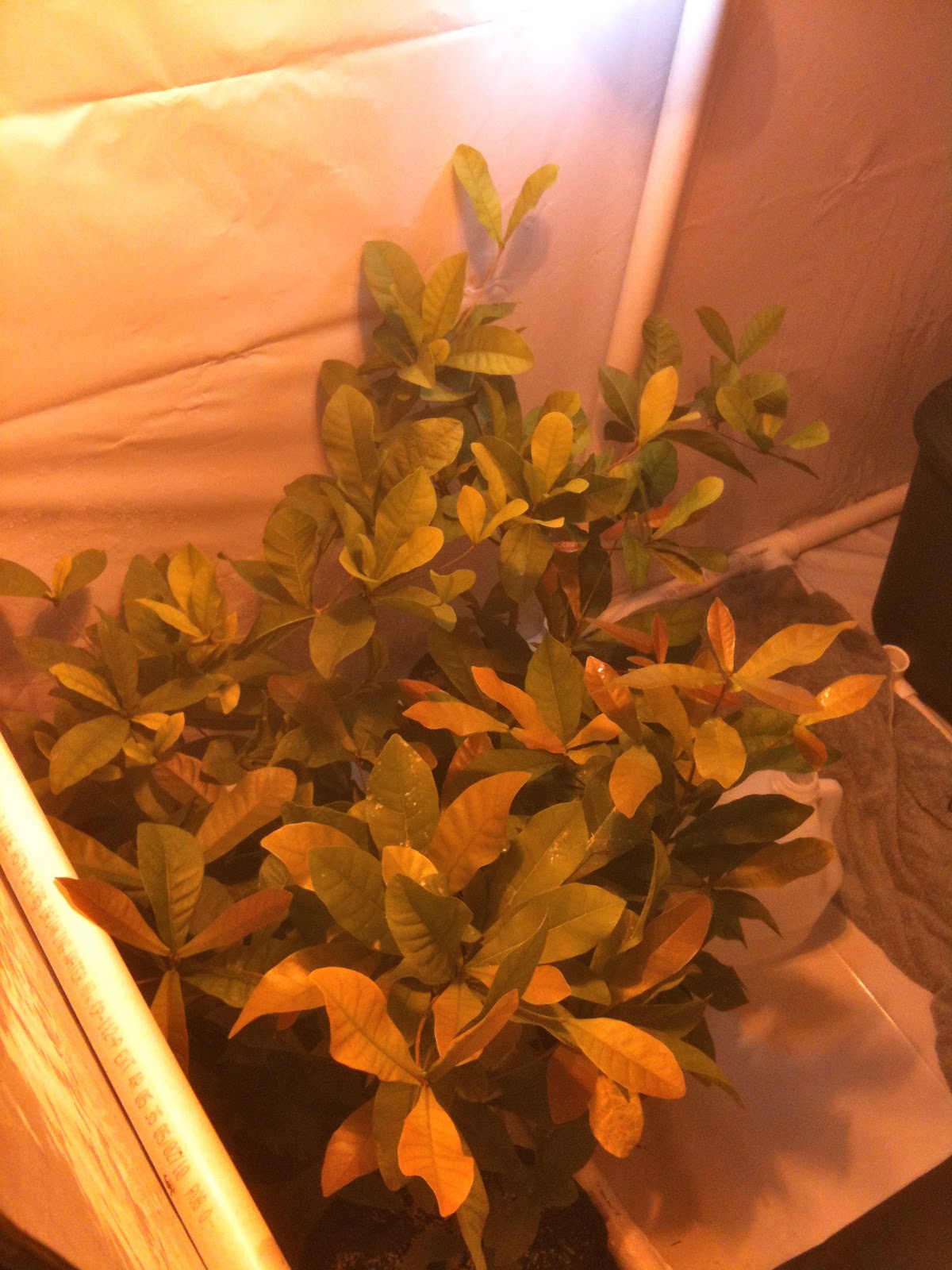
I suspect that of all the plants I have growing, the miracle fruit plants are of the most interest to the general public. For those who are not familiar with this plant, it is a native of West Africa and produces a small red berry that when eaten makes sour foods taste sweet. The berry contains a glycoprotein called “miraculin” that coats the taste buds causing this “miraculous” effect for a short period of time (typically ~30 minutes). The effect is so amazing that some people hold special “flavor tripping” parties in which a variety of foods such as lemons, oranges, vinegars, and beers are sampled under the “influence” of the berry. It should perhaps be noted that this berry has been eaten for hundreds of years and doesn’t have any known ill side effects (though this has not been cleared by the FDA, some suppose due to the sugar/ sweetner lobby). More practical uses of this berry include use for dieting (imagine a slice of lemon cake that tastes just like the real thing but is only 100 calories since it doesn’t contain sugar) as well as for helping patients undergoing chemotherapy to regain their appetite. In the latter case, the fruit is said to help remove the metallic taste that often accompanies food after chemotherapy and helps patients keep on needed weight. More research is needed before this approach has wide spread adoption but if proven true, this would certainly help the plant earn the moniker of miracle!

I currently have 6 healthy, thriving miracle fruit plants, and 1 that I am trying to nurse back to health. It is amazing how the different specimens react to exposure to the same conditions. These plants have all been growing in a wire shelving unit and some clear 3mm thick vinyl sheeting that I had left over from insulating my windows. I covered the entire rack twice and used duct tape to seal it up. A black boot tray sits on the bottom rack in order to catch dripping water and serve as a reservoir of water to keep the humidity up (a key ingredient in keeping these plants growing happily). The plants are in 1 gallon pots on the next rack, just above the boot tray. The growth medium is a 50/50 mix of peat and perlite. The next rack is about 2 and a half feet higher and has my 3 Meyer lemon seedlings and some cherimoya seed starting bags. I water with rainwater with a bit of white vinegar added (they like the acidity) and a bit of super thrive as well. I’ve had several flowers form but as of yet, no fruit, despite my attempts to hand pollinate. It is likely that increasing the intensity / shifting the spectrum of the light may help with this. I have a spare 150W HPS grow lamp (which likely has the proper spectrum/intensity for fruiting) but am worried about placing it inside of my plastic enclosure. I’m still thinking up a good balance for this so expect future posts on this topic.

In addition, I have an unused 55 gallon aquarium that I’m going to start growing a collection of these plants (~20) from seed (For 3:
3 Miracle Fruit Seeds - Turn Sour to Sweet - Synsepalum Dulcificum
For 15:
15 Miracle Fruit Seeds - End Your Dependence on Sugar! - Synsepalum Dulcificum
For 20:
9GreenBox - 20 Miracle Fruit Seeds - End Your Dependence on Sugar!
For 100 (if you want a Miracle Forest!):
9GreenBox - 100 Miracle Fruit Seeds - End Your Dependence on Sugar
). I’ve heard great things about Ethan’s Garden over at
MiracleTaste.com, a great forum for miracle fruit growers. Many sources say that germination rate for seeds is 24% but with fresh seed, it seems that over 90% germination rate is not uncommon. I’ll be posting pictures of the set up along with updates on the seeds as they germinate and grow. After about 6 months or so, once the roots have had a chance to become established and I know the plants are healthy, I may sell/trade some in order to make room for more seeds as well as the growing plants. I'd like to do some experimenting with different fertilizers, soils, and lighting conditions as well, as this is still somewhat poorly understood, at least to the general community. If growing these plants interests you, I’d encourage you to check out the
Miracle Taste forum and do some research before purchasing. These are not typical houseplants but, given the right environment, can thrive, even in Wisconsin.


 I certainly learned a great deal about creating LED lamps with high power LEDs and am fairly certain this won't be my last one (in fact, I already am scheming for a the next one). I'm hoping to boost the overall efficiency of this system but first, I'd like to see if this has any marked effect on miracle fruit production! If so, I may have some seeds to sell in the near future. Stay tuned for updates on this and my other adventures in indoor tropical gardening in the Wisconsin tundra.